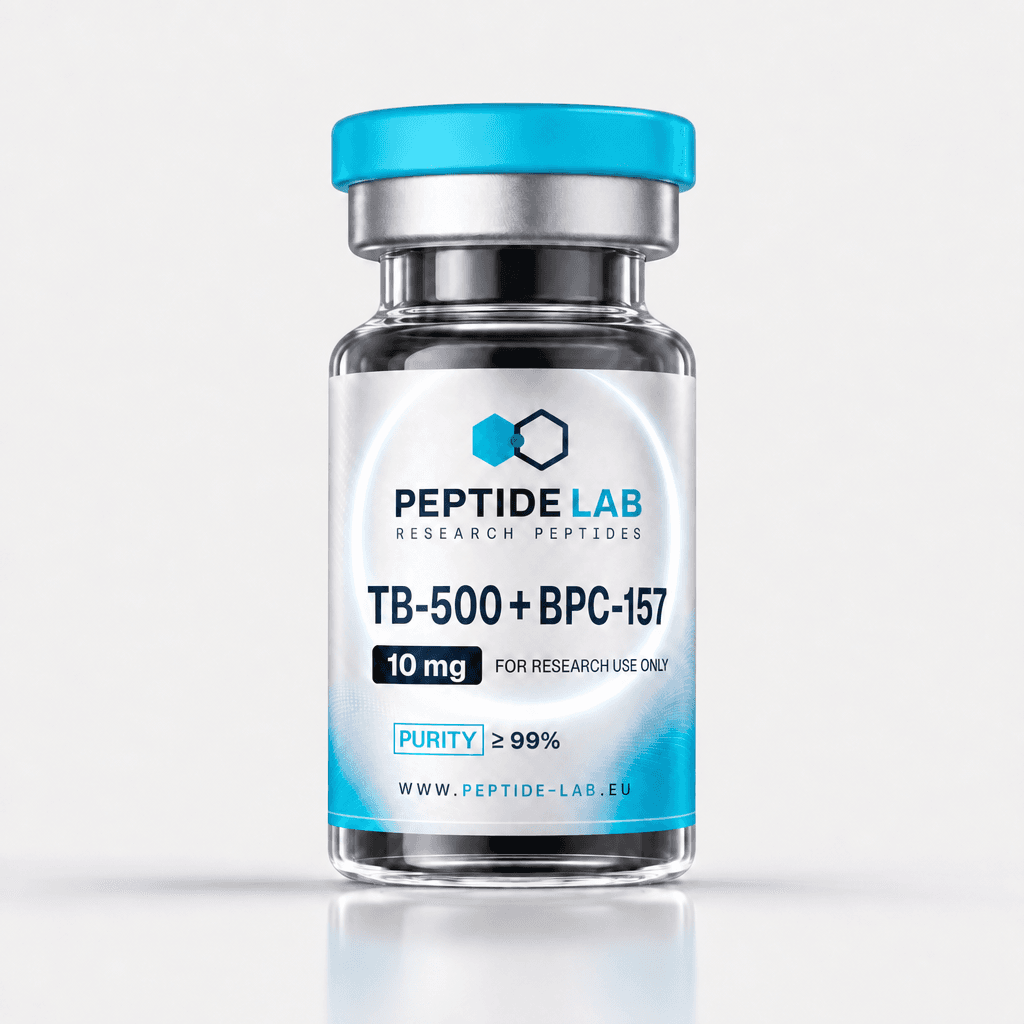
TB-500 + BPC-157 Wolverine blend
Buy TB-500 + BPC-157 Wolverine blend for research — ≥99% pure, with a Janoshik COA per batch.
Wolverine blend: BPC-157 + TB-500 in a single vial, combined for synergistic recovery, tendon and tissue support. 10 mg total, 99.0% pure.
Available to order soon
The shop will be opening soon. Leave your email address and you’ll be the first to know when orders can be placed.
Specifications
- Category
- Recovery & Healing
- Dosage
- 10 mg total per blend
- Packaging
- 1 vial (10 mg in total)
- Purity
- 99.0%
- Molecular weight
- Zie CoA
Research focus
You can buy the BPC-157 + TB-500 blend (the ‘Wolverine mix’) from Peptide Lab as a lab-verified research blend with 99.0% purity, for research purposes only. This blend combines two of the most extensively studied regenerative peptides — BPC-157 and TB-500 — in a single vial, designed for synergistic research into regeneration, tendons and tissue. Each vial contains a total of 10 mg in the form of a lyophilised powder.
Who is this blend intended for?
This blend is intended for researchers and laboratories studying tissue and repair processes who wish to combine both peptides in a single setup. The individual variants can be found under BPC-157 and TB-500; see also the Recovery & Healing category and the comprehensive guide to peptides for recovery.
Why Peptide Lab?
- Verified purity of 99.0% by HPLC and mass spectrometry.
- Batch documentation is available.
- Lyophilised powder, 10 mg in total per vial.
- Fast, discreet EU delivery.
This blend is not a medicine and is not intended for human or animal consumption.
Specifications at a glance
- Form: freeze-dried powder (blend)
- Packaging: 10 mg in total per vial
- Purity: 99.0%
- Molecular weight: See CoA
- Laboratory certificate: available on request
- For laboratory and research purposes only

Price, contents and delivery
The price of TB-500 + BPC-157 Wolverine blend is €86 per vial — that is 10 mg total per blend, which works out at €8.60 per mg. This price includes the batch-specific Janoshik certificate, linked to the lot number on the label, so you can trace exactly what you have.
- Price per vial
- €86
- Price per mg
- €8.60
- Contents
- 10 mg total per blend
- Availability
- In stock
Delivery within the EU
Postage costs €9.95 and is free for orders of €150 or more. A parcel is usually delivered within 1–3 working days, discreetly and with a tracking code. The countries and rates are listed in the delivery policy.
Order online
Online ordering isn’t available yet — the shop will open soon. Enter your email address above, and you’ll be the first to know when TB-500 + BPC-157 Wolverine blend is available to order. In the meantime, take a look at the full range in the shop.
Frequently Asked Questions
Why combine BPC-157 and TB-500?
They act via different mechanisms (angiogenesis vs. cell migration) and are described in research as complementary — all in one handy vial.
What is the ratio?
10 mg in total per blend; see the CoA for the exact composition.
Purity?
99.0%; see CoA.
How much does TB-500 + BPC-157 Wolverine blend cost?
The current price of TB-500 + BPC-157 Wolverine blend is shown at the top of this page, including the price per mg so you can compare fairly. Bundles increase the discount, and shipping is free above €150.
Is TB-500 + BPC-157 Wolverine blend legal to buy in the Netherlands?
TB-500 + BPC-157 Wolverine blend is supplied strictly for laboratory and research purposes — not as a medicine and not for human or animal consumption. Within that research-only framework it is available in the Netherlands. This is general information, not legal advice.
Reviews
- 4,03 July 2026
Great lab tested peptides
Great TB-500 + BPC-157 Wolverine mix, lab tested as promised. Lost one star because I wanted to order more but it was out of stock.
Thomas Davis· GlasgowVerified purchase - 5,07 April 2026
Highly recommend
Highly recommend this peptide lab. The TB-500 + BPC-157 Wolverine mix is excellent quality and customer service is very responsive.
Elizabeth Jones· EdinburghVerified purchase - 5,07 July 2026
Beste in Europa
Beste plek om TB-500 + BPC-157 Wolverine mix te kopen in Europa. Prijzen zijn eerlijk en de purity is top. Ga hier zeker vaker bestellen.
Peter Bos· EindhovenVerified purchaseResponse from Peptide Lab
Bedankt voor je review! Fijn dat je tevreden bent met peptide-lab.eu.
- 5,01 July 2026
Sehr gute Reinheit
Sehr gute Reinheit bei dem TB-500 + BPC-157 Wolverine mix. Dfeinitiv einer der besten Peptide Shops in Europa.
Tobias Schmidt· FrankfurtVerified purchaseResponse from Peptide Lab
Vielen Dank für Ihre Bewertung! Wir freuen uns, dass Sie zufrieden sind.
- 5,016 June 2026
Lab tested en zuiver
Zeer tevreden over de TB-500 + BPC-157 Wolverine mix. Het is duidelijk lab tested en van hoge zuiverheid. Aanrader voor best peptides europe.
Sander Dijkstra· Den HaagVerified purchase - 5,022 May 2026
Schneller Versand
Habe TB-500 + BPC-157 Wolverine mix gekauft und es kam super schnell an. Die Qualität ist top, high purity und sicher verpackt.
Martina Schneider· DüsseldorfVerified purchase - 5,020 May 2026
Lab tested en zuiver
Zeer tevreden over de TB-500 + BPC-157 Wolverine mix. Het is duidelijk lab tested en van hoge zuiverheid. Aanrader voor best peptides europe.
Peter van Dijk· Den HaagVerified purchaseResponse from Peptide Lab
Bedankt voor je review! Fijn dat je tevreden bent met peptide-lab.eu.
- 5,028 April 2026
Netjes verpakt
Snel binnen, netjes verpakt. TB-500 + BPC-157 Wolverine mix doet precies wat het moet doen. De webshop peptide-lab.eu is super overzichtelijk en betrouwbaar.
Tim Smits· Den HaagVerified purchase
Often bought together
Related products
Further reading on this research
FOR RESEARCH USE ONLY. For laboratory and research purposes only. Not for human or animal consumption; not a medicine and does not constitute medical advice.