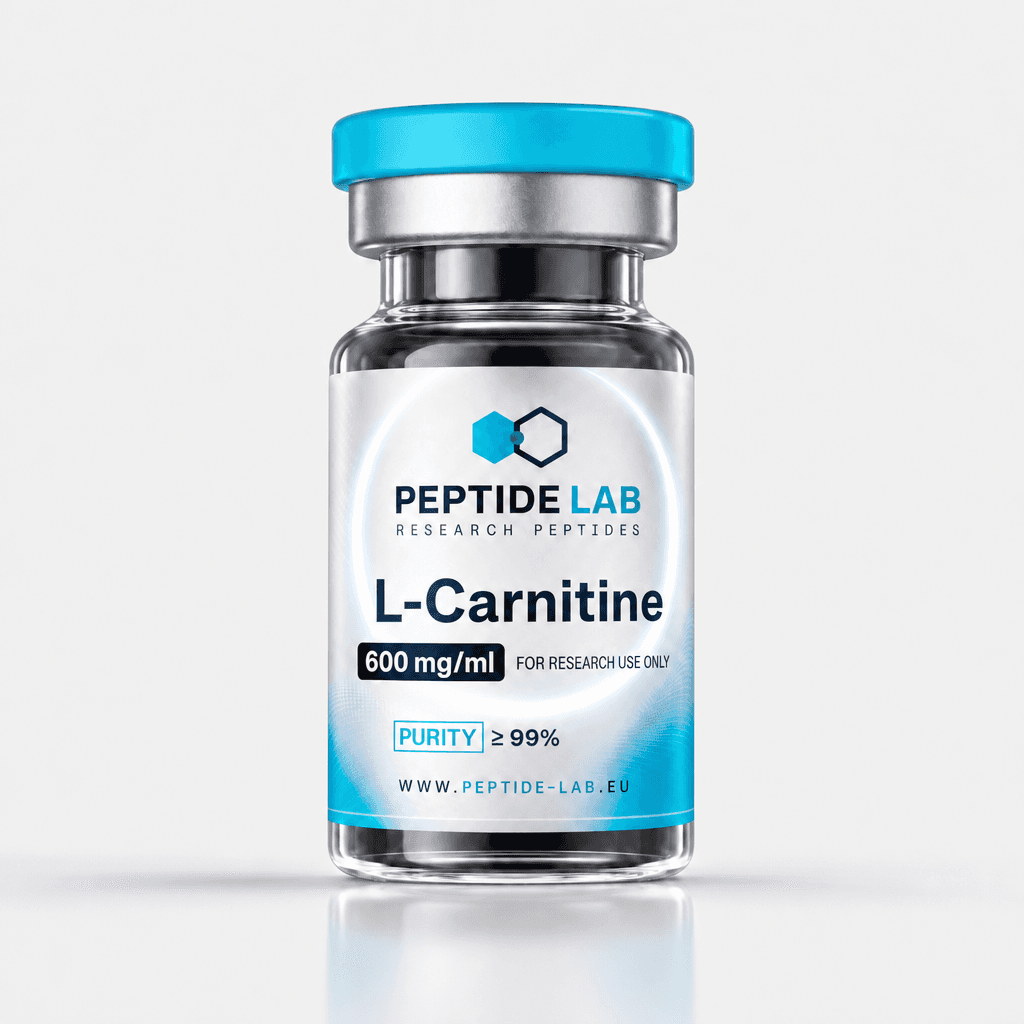
L-Carnitine sits in the catalogue among the research peptides, but strictly speaking it isn't one. In this guide we explain, research-only, what L-Carnitine actually is, why it still fits the metabolism category, and which research themes it is studied within.
L-Carnitine is not a peptide, but an amino-acid-derived compound involved in transporting fatty acids to the mitochondria. It is studied within metabolism research, alongside peptides such as MOTS-C. No weight-loss or health claims, research-grade material only.
What is L-Carnitine, if it isn't a peptide?
L-Carnitine is a quaternary ammonium compound the body synthesises itself from the amino acids lysine and methionine — not a chain of amino acids like a peptide, but amino-acid-derived nonetheless. Peptide Lab offers it within the metabolism category due to the direct research overlap. New to peptides? First read what peptides are.
Why is L-Carnitine studied in metabolism research?
In research, L-Carnitine is studied for its role in transporting long-chain fatty acids to the mitochondria, where they are converted into energy. That role in fatty-acid transport makes it a recurring subject in metabolic and physiological research. These descriptions come from preclinical and physiological research and are no proof of effect or usage advice.
L-Carnitine versus metabolic research peptides
L-Carnitine and peptides such as MOTS-C are both studied within metabolism research, but via different mechanisms. Read more about the mitochondrial peptide MOTS-C, or browse the full fat loss & metabolism category.
Purity and documentation
Reproducible metabolic research requires material with verified purity and full traceability. Every batch of L-Carnitine at Peptide Lab is tested by Janoshik Analytical, with a public certificate per lot number. Read more about our approach on the science page.
This information is general and intended solely for a research context. Peptide Lab supplies L-Carnitine for laboratory and research purposes only. Not for human or animal consumption, not a medicine, not a weight-loss product and not medical advice.
Frequently asked questions about L-Carnitine
Is L-Carnitine a peptide?
No. L-Carnitine is not a peptide (not a chain of amino acids), but an amino-acid-derived quaternary ammonium compound. Peptide Lab offers it within the fat loss & metabolism category because the research field overlaps with metabolic research peptides.
What is L-Carnitine studied for in research?
In research, L-Carnitine is studied in relation to the transport of fatty acids to the mitochondria, where they are converted into energy. This concerns physiological and preclinical research, without health or weight-loss claims.
How does L-Carnitine compare to metabolic research peptides such as MOTS-C?
L-Carnitine and MOTS-C are both studied within metabolism research, but via different mechanisms: L-Carnitine in fatty-acid transport, MOTS-C in mitochondrial signalling and the AMPK pathway. They are complementary, not identical, research subjects.
Is L-Carnitine from Peptide Lab pure?
Yes, L-Carnitine is lab-verified for purity by HPLC and mass spectrometry, with a public Janoshik certificate per batch. For research purposes only.